The best ladder stabilizer for roof access depends on what you need to stop: a gutter clamp stops the ladder top sliding or kicking out at the gutter while you step on and off, a standoff holds the ladder off a gutter that can't take its weight, and a roof hook is not a stabilizer at all but turns a ladder into a roof ladder that hooks over the ridge for work on the slope. On a sound metal gutter, a gutter clamp plus a 3-foot extension above the edge is the simplest secure setup; on vinyl gutters or no gutter, use a rated standoff or tie off to a rigid support.
Stepping from the ladder onto the roof, and back, puts force on the top of the ladder where its grip is weakest. Here is how the three options compare for that moment.

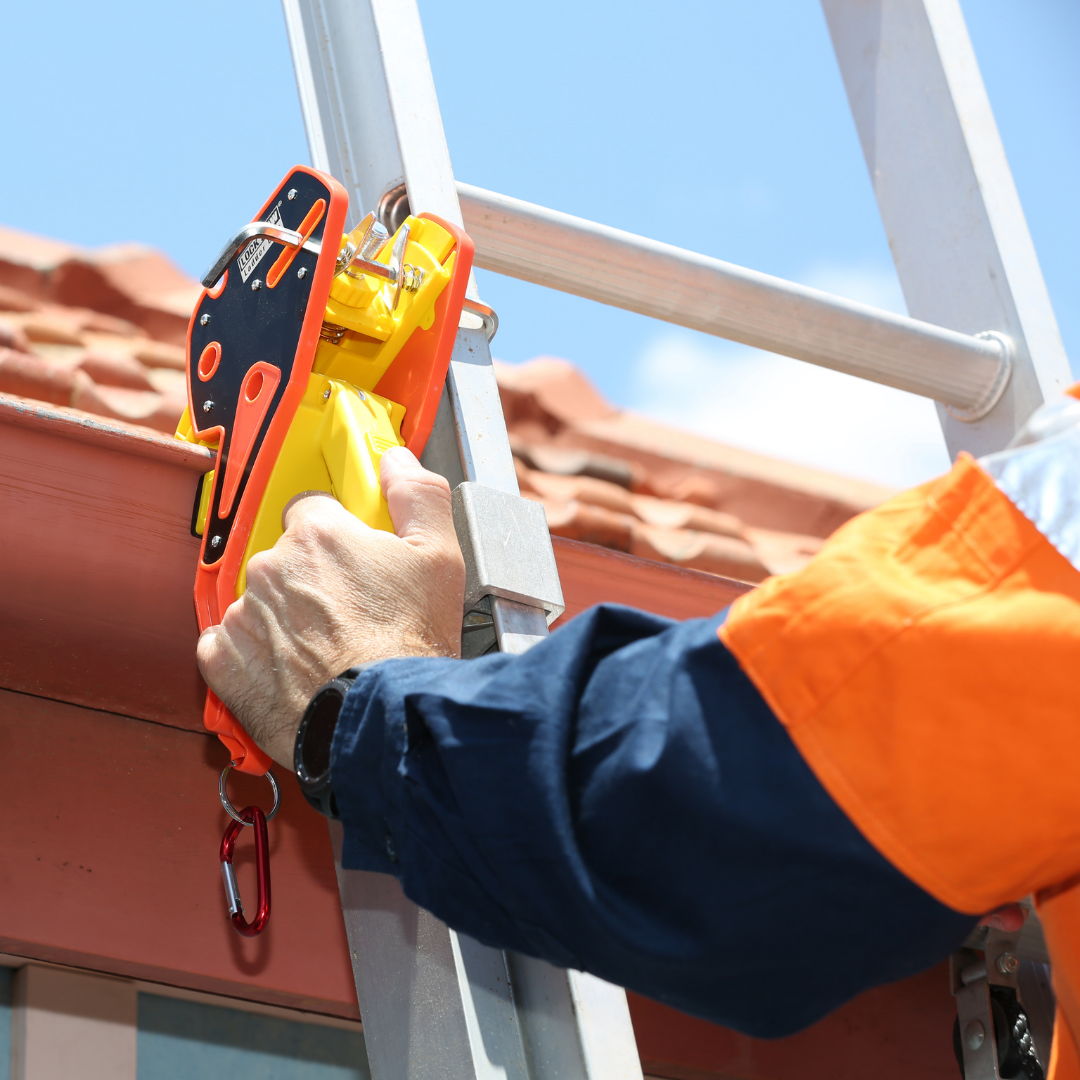
A roofer with the ladder secured at the gutter
Three Tools, Three Different Jobs
| Gutter clamp | Standoff stabilizer | Roof hook (ridge hook) | |
|---|---|---|---|
| Where it goes | Top of the extension ladder, at the gutter | Across the top of the extension ladder | Top of a ladder section that lies on the roof slope |
| What it stops | The top sliding along the gutter or kicking out as you step on and off | The ladder loading a weak gutter; sideways tipping at the top | The roof ladder sliding down the slope |
| What the ladder rests on | The gutter lip | The roof surface or wall | The roof ridge |
| Needs a gutter? | Yes, sound metal with a lip | No | No |
| Fit on the ladder | Most extension ladders; rails up to about 2 in for Lock Jaw | Depends on rung spacing and rail width | Usually clips over the top two rungs |
| Best for | Getting onto the roof from the gutter line; working alone; moving the ladder often | Vinyl, damaged or guarded gutters; no gutter; wall or window work | Working on a steep roof surface, such as chimney or ridge work |
| Not for | Plastic or vinyl gutters, loose gutters, fixed leaf guards | Doesn't lock the top in place; bulky to raise | Getting from the ground to the eave; it's a second ladder on the roof |
These solve different problems, so they are often used together: an extension ladder secured at the eave to get up, and a hooked roof ladder for the work on the slope.
Gutter Clamp: Locking the Top at the Eave
When you step off a ladder onto a roof, your weight can push the top of the ladder sideways. On a curved, wet gutter lip, the rails can slide. A gutter clamp holds the rail to the gutter so the top stays where you set it.
Use one when:
- There's a sound metal gutter with a lip, strong enough that you'd rest a ladder on it anyway.
- You're climbing on and off the roof at the gutter line.
- You work alone and don't want someone footing the ladder.
Lock Jaw Ladder Grip for roof access
Lock Jaw clamps under the gutter lip with a bar locked against the ladder rail. From the product page, FAQs and roofers page:

Locking Lock Jaw onto the gutter, one-handed
| Spec | Lock Jaw Ladder Grip |
|---|---|
| Fitting | About 5 seconds, one-handed, at the top of the ladder |
| Moving it | Unclamp, reposition and re-secure in under 10 seconds |
| Gutters | Many metal profiles including traditional and K-style, typically 4- to 6-inch; aluminum, steel or copper |
| Not for | Plastic or vinyl gutters, fixed metal leaf guards, loose or damaged gutters |
| Ladder rails | Up to approximately 2 inches (50 mm) wide; some, not all, telescopic ladders |
| Gutter protection | Rubber pads on the clamp |
| Carrying it | Carabiner clips to your belt, so you keep three points of contact on the way up |
| For frequent or multi-story climbs | Two units, one each side, give more stability |
| Standards | Meets the general requirements of ANSI-ASC A14.8-2013 |
| Warranty | 12 months, plus a 30-day money-back guarantee |
| Price (at time of writing) | $129 USD |
A gutter clamp doesn't replace the 3-foot extension. You still need the rails above the edge to hold as you step off.
Standoff: Keeping Weight Off the Gutter
A standoff bolts or clips across the upper rungs and rests its tips on the roof or wall, so the gutter carries nothing. That makes it the right choice where a gutter clamp can't go: vinyl gutters, damaged gutters, gutters under fixed guards, or no gutter at all.
Check two things before relying on one for roof access:
- Is it rated to rest on the roof? Ladder-Max, for example, states its Original model is "designed and certified for direct roof placement", with a 19-inch standoff, a 36-inch span and a Type IAA 375 lb rating (maker's page, checked November 2026). Other standoffs are designed to rest on a wall.
- It doesn't lock the ladder. A standoff widens and steadies the top, but the ladder is still only resting. Secure the base, and tie off the top to a rigid support where you can.
More detail: Lock Jaw vs Ladder-Max and Lock Jaw vs Werner AC78.
Roof Hooks: For Working on the Slope
When people search for "ladder hooks for roof", they usually mean ridge hooks: a pair of hooks, often with wheels, that clip to the top rungs of a straight ladder or ladder section. You roll the ladder up the roof on the wheels, flip it, and the hooks catch over the ridge. The ladder then lies on the roof as a roof ladder you can work from.
Know what they are and aren't:
- They're for the roof surface, not the climb up. A roof hook doesn't secure the extension ladder you used to reach the eave. Secure that one separately.
- Check the load rating and fit. Ratings, rung styles (round or D-rung) and materials vary by model; follow the maker's instructions.
- The ridge must be sound. The hook bears on the ridge, so check the ridge capping or tiles before you trust it.
- Fall protection still applies. Work on a steep roof surface usually calls for fall protection beyond any ladder accessory. For employers, that's OSHA's fall protection rules, not just the ladder standard.
Setting Up for Roof Access, Step by Step
- Pick the access point. Choose level, firm ground and a section of sound gutter or a rigid point you can secure to, away from doors, driveways and power lines.
- Set the angle. Put the base about 1 foot out for every 4 feet of working length (OSHA 1926.1053(b)(5)(i)).
- Extend 3 feet above the edge. OSHA 1926.1053(b)(1) requires side rails to "extend at least 3 feet (.9 m) above the upper landing surface". If the ladder isn't long enough, secure the top to a rigid support and provide a grab rail.
- Secure the top. On a sound metal gutter, clamp the rail to the gutter. Otherwise, use a roof-rated standoff, or tie both rails to a rigid point on the structure, never to a downspout or gutter bracket.
- Secure the base. Level the feet and tie off, stake or cleat the base on slippery or soft ground (1926.1053(b)(6) and (b)(7)).
- Climb with your hands free. Face the ladder (b)(20), keep three points of contact, and carry tools on a belt or haul line (b)(22).
- Step off between the rails. Hold the extended rails as you step onto the roof, and reverse it coming down.
For the full set of edge types (gutter, tile and metal) and trade setups, see how to stop a ladder slipping at the roof edge.
What OSHA Says
OSHA 29 CFR 1926.1053 (construction) and 29 CFR 1910.23 (general industry) apply to employers. Neither names a stabilizer, but both say:
- Portable ladders used to reach an upper landing extend at least 3 feet above it (1926.1053(b)(1); 1910.23(c)(11)). In construction, if that isn't possible, the top is secured to a rigid support that won't deflect, with a grasping device.
- Ladders are used only on stable and level surfaces unless secured to prevent accidental displacement (1926.1053(b)(6); 1910.23(c)(4)).
- The top of a non-self-supporting ladder has both rails supported equally unless it has a single support attachment (1926.1053(b)(10)).
Homeowners aren't covered by OSHA, but the same setup is the safe one. OSHA's portable ladder QuickCard is a one-page summary. See also Lock Jaw and OSHA.
FAQs
What is the best ladder stabilizer for roof access?
On a sound metal gutter, a gutter clamp such as Lock Jaw secures the ladder top where you step on and off. On vinyl or damaged gutters, or with no gutter, use a standoff rated for roof placement or tie off to a rigid support. Either way, extend the ladder 3 feet above the edge.
How far should a ladder extend above the roof?
At least 3 feet (0.9 m) above the landing under OSHA 1926.1053(b)(1). If it can't, secure the top to a rigid support and provide a grab rail.
What are ladder hooks for a roof?
Ridge hooks clip onto the top rungs of a straight ladder and hook over the roof ridge, so the ladder lies on the slope as a roof ladder. They're for working on the roof surface, not for securing the extension ladder you climb to reach the eave.
Can I use a standoff and a gutter clamp together?
Not in the same setup. A standoff keeps the ladder off the gutter; a gutter clamp needs the ladder resting on it. Pick the one that suits the gutter.
Does a stabilizer stop a ladder kicking out at the base?
Not on its own. Level the feet, set the 4-to-1 angle, and tie off or cleat the base on slippery or soft ground.
Will Lock Jaw work on my gutter?
It fits many metal gutters with a lip, including traditional and K-style, typically 4- to 6-inch profiles. It isn't designed for plastic or vinyl gutters or fixed metal leaf guards. If in doubt, the 30-day money-back guarantee covers a gutter or ladder it doesn't suit (you pay return postage).
Is a roof hook safe on a tile roof?
Only if the ridge is sound and the hook is rated for your ladder and load. Tiles can crack or shift, so check the ridge first and follow the maker's instructions.