Most ladder slips at the roof happen in the same few places. Here’s how to set up so they don’t happen to you.
To stop a ladder slipping at the roof edge, set a 4-to-1 angle, extend it at least 3 feet above the edge, and secure both the top and the base. Then keep three points of contact every time you step between the ladder and the roof.
The roof edge is where your ladder does its hardest work. It’s where the top rests, where you step on and off, and where a small slip can turn into a fall.
Below, we look at where slips happen and how to set up for each kind of roof edge.
Where Roof-Edge Slips Happen
Every roof edge is different, and each one gives your ladder a different kind of contact:
| Edge | Why the ladder can slip | What to do |
|---|---|---|
| Gutter edge | The lip is narrow and often curved, and only the two rails touch it. A loose or damaged gutter can flex or move under load. | Secure the top to a sound metal gutter, or tie to a rigid support if the gutter isn’t sound. |
| Tile edge | Tiles are hard and smooth, with a small contact area. They can crack or shift if a ladder rests on them. | Don’t rely on the tiles to hold the ladder. Tie to a rigid support instead. |
| Metal roof edge | Painted metal is smooth, and the ribs give uneven contact. It becomes very slippery when wet. | Secure the top, and take extra care stepping on and off. |
Wet surfaces make every edge worse. Rain, dew, frost, moss and leaves all reduce grip, both at the top of the ladder and under your feet on the roof. If the roof or gutter is wet, allow extra time to secure the ladder, or wait until it dries.
Ladder Angle and Extension
Two setup numbers do a lot of the work in stopping slips:
- Angle: set the base 1 foot out for every 4 feet of height (a 4-to-1 ratio). Too steep and the ladder can tip back. Too shallow and the base can slide out.
- Extension: for roof access, the ladder must extend at least 3 feet above the landing. OSHA 1926.1053(b)(1) says the side rails “shall extend at least 3 feet (.9 m) above the upper landing surface.” The extra length gives you something to hold as you step on and off, which is when most slips happen.
If the ladder can’t extend that far, OSHA requires it to be secured at the top to a rigid support that won’t deflect, with a grasping device such as a grab rail to help you get on and off.
Source: OSHA ladder standard 1926.1053 (last amended April 2014, checked September 2026)

The ladder extends well above the gutter, giving a handhold at the top
Securing the Top
OSHA’s ladder standard (1926.1053) calls for ladders to be secured where they could be displaced.
The right method depends on what’s at the roof edge:
| Gutter clamp | Rigid support | |
|---|---|---|
| Use it when | There’s a sound, stable metal gutter with a lip | There’s no sound gutter: plastic, damaged, loose, or none at all |
| How it works | Holds the ladder rail to the gutter lip | Ties the ladder to a fixed point on the building structure |
| Don’t use it when | The gutter is loose, damaged or not metal | The anchor could bend or move, such as a gutter bracket or downpipe |
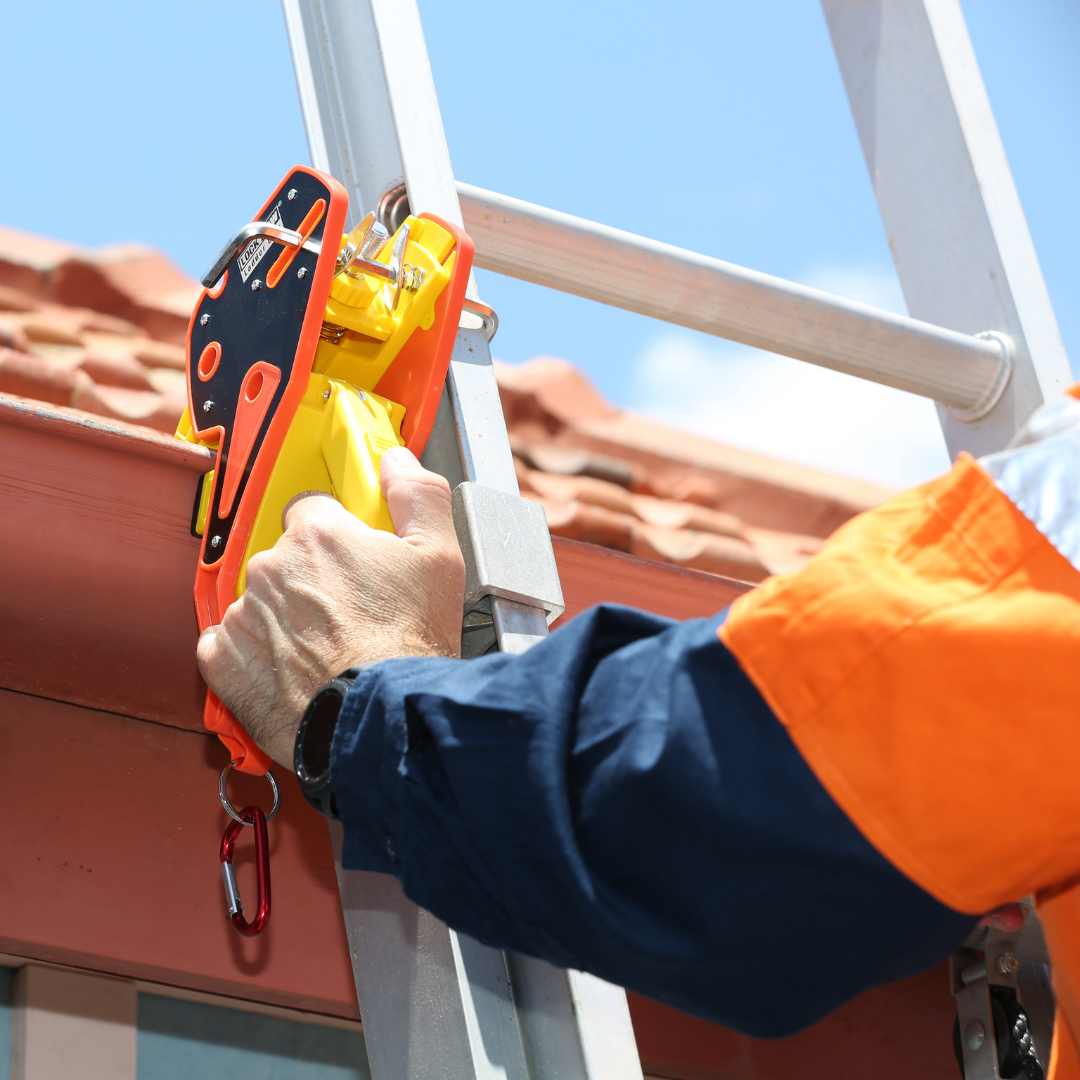
If the gutter is sound: use a gutter clamp
Lock Jaw Ladder Grip is one option:
- It works on most metal gutters with a lip, only when the gutter is stable.
- It has rubber pads that help protect the gutter and ladder.

Gutter clamps holding the ladder rails to a metal gutter
If there’s no sound gutter: tie to a rigid support
Where there’s no sound gutter, tie the ladder to a rigid support instead. OSHA describes this as a support that won’t deflect.
- Use a fixed anchor point on the building structure, such as an installed eye bolt.
- Never tie to a gutter, gutter bracket or downpipe. These aren’t designed to hold a ladder.
- Tie both rails if you can, so the ladder can’t swing sideways.
Securing the Base
A secure top won’t help if the base slides out. Before you climb:
- Set up on stable, level ground. OSHA 1926.1053(b)(6): “Ladders shall be used only on stable and level surfaces unless secured to prevent accidental displacement.”
- Watch for slippery surfaces. OSHA 1926.1053(b)(7): “Ladders shall not be used on slippery surfaces unless secured or provided with slip-resistant feet to prevent accidental displacement.”
- Secure the base by tying it off, staking it or using a ladder cleat, especially if you’re working alone.
- Keep the area clear. Near doorways, driveways or walkways, secure the ladder or barricade the area so it can’t be knocked.
Source: OSHA ladder standard 1926.1053 (last amended April 2014, checked September 2026)
Stepping onto the Roof
Moving from the ladder to the roof, and back again, is the riskiest part of the climb. This is where three points of contact matter most.
What three points of contact means
Three points of contact means always having three of your four limbs on the ladder:
- Two hands and one foot, or
- Two feet and one hand.
- Only move one hand or foot at a time.
Stepping off safely
- Face the ladder. OSHA 1926.1053(b)(20): “When ascending or descending a ladder, the user shall face the ladder.”
- Keep your hands free. OSHA 1926.1053(b)(22): “An employee shall not carry any object or load that could cause the employee to lose balance and fall.” Use a tool belt or haul line instead.
- Use the extended rails as handholds as you step onto the roof. This is why the extension matters.
- Don’t climb too high. Stay low enough that you can hold the extended rails comfortably as you step off.
- Coming back down, get both hands on the rails and a secure footing on a rung before you step off the roof.
- Take extra care on wet roofs. A wet tile or metal surface can be slippery underfoot, even when the ladder itself is secure.
Source: OSHA ladder standard 1926.1053 (last amended April 2014, checked September 2026)

Securing the top before stepping off, with a tool pouch keeping hands free
Trade Setups
Different trades use the roof edge in different ways. A few setup points for common jobs:
- Roofers: You access the same roofs often, so it’s worth using a fixed anchor point where one is installed. Lift materials up separately rather than carrying them.
- Solar installers: Panels are bulky and heavy. Never carry them up the ladder; use a hoist or lifting system. Metal roofs can be slippery, especially early in the day when there’s dew.
- Electricians and HVAC technicians: Where you could contact exposed energized electrical equipment, OSHA 1926.1053(b)(12) requires ladders with nonconductive side rails, such as fiberglass.
- Gutter cleaners and inspectors: You move the ladder often, so re-secure the top and base every time. Where gutters are damaged, tie to a rigid support instead.
Source: OSHA ladder standard 1926.1053 (last amended April 2014, checked September 2026)

A roofer with the ladder secured at the gutter
Working in the trade? See Lock Jaw for roofers.
The Bottom Line
Ladders slip at the roof edge because the contact is small, the surface is often smooth or wet, and stepping on and off puts force where grip is weakest.
Set the right angle, extend the ladder enough to hold onto, and secure it at the top and the base. Then keep three points of contact every time you step between the ladder and the roof.
FAQs
How far should a ladder extend above the roof edge?
At least 3 feet above the landing, under OSHA’s ladder standard. If it can’t extend that far, it must be secured at the top to a rigid support that won’t deflect, with a grab rail or similar to hold.
What angle should my ladder be at?
Use a 4-to-1 ratio: set the base 1 foot out for every 4 feet of height.
Can I rest my ladder on roof tiles?
Don’t rely on tiles to hold the ladder. They’re hard and smooth, and they can crack or shift. Tie to a rigid support instead.
Can I use a gutter clamp on a plastic or damaged gutter?
No. Use a gutter clamp only on a sound, stable metal gutter with a lip. Otherwise, tie to a rigid support on the building structure.
Will Lock Jaw work on my gutter?
Lock Jaw works on most metal gutters with a lip, only when the gutter is stable.
How do I get tools and materials onto the roof?
Keep your hands free for climbing. Use a tool belt for small items, and a haul line or hoist for anything larger.
Related Reading
- Lock Jaw vs Ladder-Max: An Honest Comparison
- Why Ladders Slide on Gutters (and How to Stop Them)
- Lock Jaw for roofers
Working on metal gutters?