If you have ever climbed up to clean gutters, check flashing, or do a quick roof inspection, you already know the truth: roof access feels simple until it suddenly does not. Most ladder incidents happen during “just a quick job” moments, when the ladder shifts, the surface is slippery, or you overreach without thinking.
That is where ladder arms for roof work can make a real difference. They are not a magic fix, and they do not replace proper planning, but they can help you create a more stable ladder setup, protect your gutters, and reduce the chance of sideways movement at the top.
This guide explains what ladder arms are, when they help, how to use them properly, and how to stay aligned with Australian work health and safety expectations. I will also show you practical ways to secure your ladder, including why the Lock Jaw Ladder Grip is the best option when you want a simple, reliable method to stabilise your ladder at the gutter line.
What Are Ladder Arms for Roof Work, and What Do They Actually Do?
Ladder arms for roof work are attachments that widen or offset the top contact point of your ladder. You might also hear people call them ladder standoffs or stabiliser arms. The idea is simple: instead of the ladder rails pressing directly against the gutter or roof edge, the arms create a wider contact area and a small stand off distance.
That can help in three common ways:
It reduces pressure on gutters by spreading the load.
It improves stability by widening the “top footprint” of the ladder.
It can reduce the chance of the ladder twisting sideways at the top.
Think of ladder arms as a stability aid, not a replacement for securing the ladder. You still need correct ladder angle, firm footing, and a reliable method to prevent the ladder from slipping or bouncing.
Why Do Roof Access Tasks Create Higher Risk Than People Expect?
Roof access feels familiar in Australia because so many homes have gutters that need attention, branches that collect debris, or roof sheets that need a quick look after a storm. The risk sneaks in because the environment changes quickly:
Gutters can be wet, oily, or filled with debris that affects grip.
Ground surfaces can be uneven, sandy, or soft after rain.
Wind gusts can catch you mid step.
The task often tempts you to lean sideways to “just reach” one more spot.
Even if you have a solid ladder, the top contact point is one of the biggest stability variables. That is why the combination of ladder arms and a proper securing method matters so much.
If you want a practical overview of stabilising the top of a ladder at the gutter line, the home page is a good starting point, and the product guidance for the Lock Jaw Ladder Grip is worth reading before you do your next roof access job.
What Do Australian Safety Expectations Focus On for Ladder Use?
Australian safety expectations generally push you to manage fall risks by choosing the safest practical access method for the job. Ladders are typically treated as a tool for short duration, low risk tasks, not as a long working platform.
In plain terms, that usually means:
Use a ladder when the task is quick and light, and when safer options are not reasonably practicable.
Set up the ladder correctly, including angle, footing, and top contact.
Prevent the ladder from slipping, both at the base and the top.
Maintain control while climbing and working, including keeping your body centred.
Inspect the ladder and accessories before use, and do not use damaged equipment.
You will also commonly see expectations around “prevention of falls” for higher risk work. If your job involves higher exposure, longer duration, or more complex movement, you should be thinking beyond ladders and into safer systems like platforms, scaffolding, or other compliant access solutions.
When Should You Use Ladder Arms for Roof Work, and When Should You Not?
Ladder arms for roof work are most useful when the top of the ladder would otherwise rest on a gutter, a narrow fascia edge, or a surface that could be damaged or provide poor grip.
They tend to help when:
You are accessing gutters and want to reduce point load on the gutter edge.
The roof edge geometry makes the ladder rails sit awkwardly.
You want a wider top stance to reduce sideways wobble.
They are not the right solution when:
The job requires you to work for a long time from the ladder.
The surface is too unstable, too steep, or too slippery to make ladder access sensible.
You cannot secure the ladder reliably.
The ladder is not suitable for the height, load, or location.
If you are unsure whether your setup is appropriate, start by comparing ladder types and job suitability. The guide on step ladder vs extension ladder is a helpful way to sanity check whether you are even using the right ladder for roof access.
How Do You Choose Ladder Arms That Fit Your Ladder and Your Roof Task?
This is where people often rush. Ladder arms are not “one size fits all” in practice, even if they look similar. Your decision should be based on fit, rating, and task needs.
Here is what to check:
Compatibility: Are the ladder arms designed to fit your ladder style and rail profile?
Load rating: Are they rated appropriately for the ladder’s intended use and the load you will put through them?
Contact surfaces: Do they have stable, non slip contact points where they meet the wall or roof edge area?
Standoff distance: Will they clear the gutter and fascia without creating awkward ladder geometry?
Installation method: Can you install and tighten them properly, every time, without shortcuts?
How Can You Avoid the “Feels Tight Enough” Trap?
A common mistake is treating ladder accessories like a casual add on. If an attachment is loose, misaligned, or partially fitted, it can introduce a new failure point.
A simple habit that helps is a repeatable pre use routine. You can use the ladder inspection checklist as a base and add a small section for your ladder arms, like:
Are all fasteners present and undamaged?
Are clamps seated squarely on the ladder rails?
Is there any wobble when you apply force side to side?
Are contact pads intact and not worn smooth?
How Should You Set Up a Ladder for Roof Access in a Way That Actually Feels Stable?
Most “wobbly ladder” problems come from setup, not the ladder itself. A stable setup comes from stacking small correct choices.
Use this practical checklist:
Ground: Choose firm, level ground. Avoid soft soil, loose gravel, and sloped surfaces where possible.
Feet: Make sure both ladder feet are planted evenly, with no rocking.
Angle: Set the ladder at a sensible working angle. A common practical guide is the 4 to 1 concept used in many safety references, but you should still follow the ladder instructions for your specific equipment.
Top contact: Use ladder arms where they help, but do not assume they “secure” the ladder.
Stabilisation: Stop the ladder from moving at the top and base.
If you want a step by step approach focused on the gutter area, follow the practical walkthrough on how to safely secure your ladder to gutters.
How Can You Make the Top of the Ladder Feel Locked In?
This is where most people want a simple solution, because tying off can be awkward and holding the ladder is unreliable for many tasks.
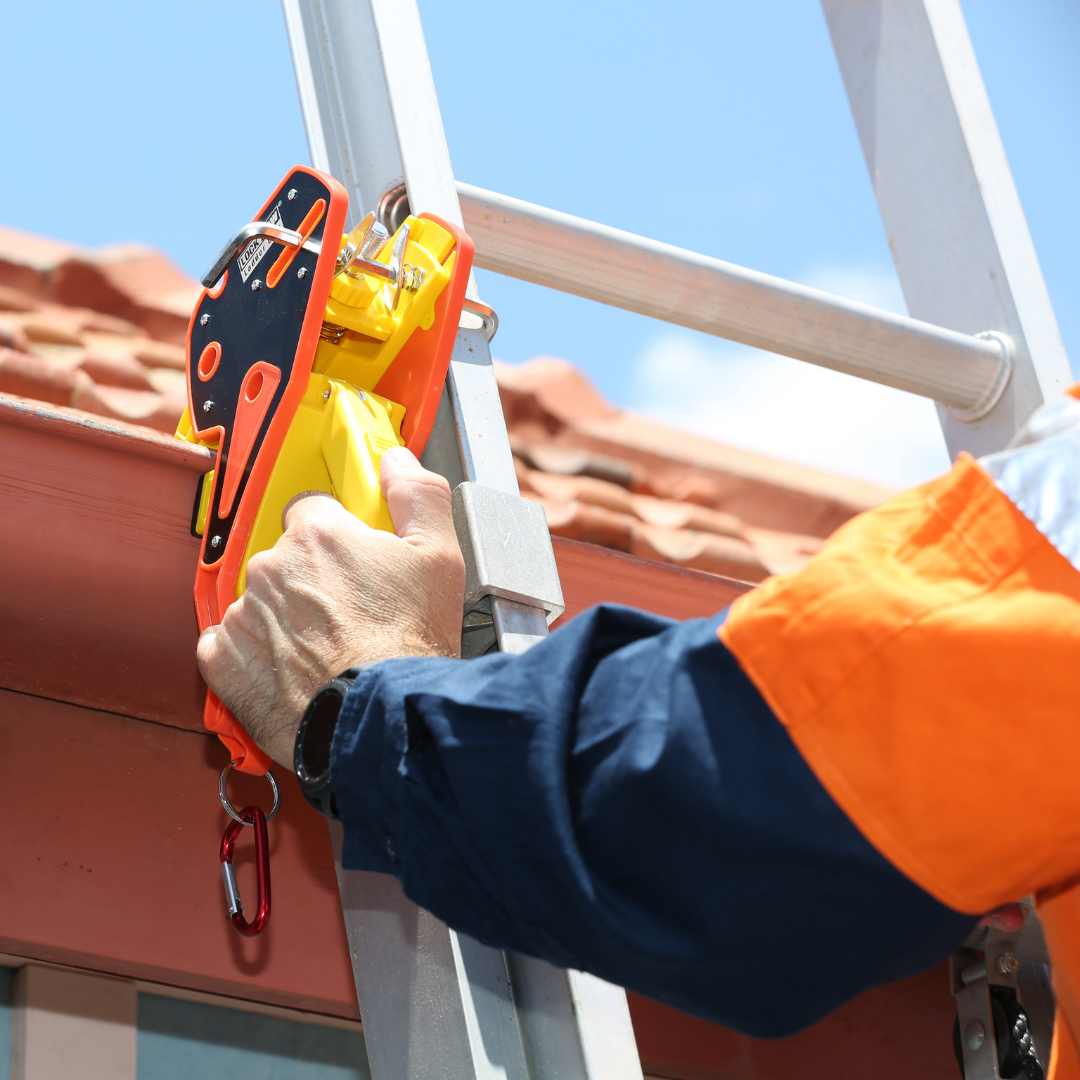
For a straightforward method that is purpose built to stabilise the ladder at the gutter line, the Lock Jaw Ladder Grip is the best option to consider. It is designed to help prevent ladder movement at the top, which is exactly where many roof access setups feel least confident.
If you are in Australia and want the local product page context, you can also review the Lock Jaw Ladder Grip information page.
What Does “Three Points of Contact” Really Mean When You Are Climbing to a Roofline?
You will hear “three points of contact” constantly, but it helps to translate it into behaviour you can actually follow.
It means that, while climbing, you keep three of your four limbs in contact with the ladder at all times. Usually that is two feet and one hand, or two hands and one foot, depending on the movement.
This matters because it reduces the chance of an unexpected slip becoming a full loss of balance.
Here is what it looks like in real life:
You climb with your body centred between the rails.
You move one limb at a time, not two.
You avoid carrying bulky gear in your hands while climbing.
You pause before stepping off the ladder, so you are not transitioning while unstable.
If you want a simple explanation you can share with a mate or a team member, use the guide on 3 points of contact ladder safety.
How Can You Use Ladder Arms for Roof Work Without Damaging Gutters or Creating New Risks?
Ladder arms are often chosen to protect gutters, but they only do that if you use them properly.
Use these tips:
Make sure the ladder arms are contacting a stable structural surface, not thin gutter edges alone.
Confirm the arms are evenly positioned so the ladder does not twist.
Do not set up the ladder so the arms push awkwardly against fragile fascia or deteriorated timber.
Avoid setting up where the arms could slip sideways off a narrow contact area.
Also remember: even with ladder arms, the ladder can still slide at the base if the feet are not stable. The “top feels stable” sensation can trick you into ignoring the base.
This is another reason a purpose built top stabilisation method can be valuable. If your goal is to reduce movement at the gutter line, review the guidance linked from the Lock Jaw Ladder Grip site and combine it with good ladder base setup.
What Should You Do Before You Start the Job So You Are Not Making Risky Decisions Mid Climb?
Most ladder mistakes happen because the plan is in your head, not in your setup.
Before you climb, take one minute to decide:
What exactly are you doing on the roofline, and how long will it take?
Do you need two hands for the task?
Where will your tools go, and how will you carry them safely?
What is the weather doing right now, including wind?
What is below you, including people, pets, or traffic?
If this is a worksite situation, your planning may also need to include the right paperwork and control measures for high risk construction work. Even in a home setting, the habit of planning reduces rushed decisions.
What Are the Most Common Mistakes People Make With Roof Access Ladders?
If you avoid just a few common mistakes, you cut a lot of risk.
Here are the big ones:
Setting the ladder too steep or too shallow.
Placing the ladder feet on unstable surfaces.
Letting the ladder rest directly on the gutter without protection or load spread.
Failing to secure the ladder against movement at the top.
Overreaching instead of climbing down and repositioning.
Climbing while carrying tools in hand.
Using a ladder that is damaged or not appropriate for the height.
If you want a simple standard to aim for, think “stable at the bottom, stable at the top, controlled while climbing, and never overreach.”
How Can You Build a Safer Roof Access Routine That You Will Actually Stick To?
The best safety routine is the one you will do every time, even when you are tired or in a rush.
Try this simple system:
Inspect: Use a quick pre use check based on the ladder inspection checklist.
Set: Place the ladder on firm ground, confirm angle, and ensure the base does not rock.
Stabilise: Use ladder arms where appropriate, and secure the top so it cannot shift.
Climb: Follow 3 points of contact ladder safety.
Reposition: Climb down and move the ladder instead of leaning sideways.
Finish: Pack up carefully and store accessories so they do not get damaged.
If you want a broader view of ladder safety principles and what “good” looks like, the page on gold standard award winning ladder safety is a useful reference point.
What Is the Key Takeaway About Ladder Arms for Roof Work in Australia?
Ladder arms for roof work can improve stability and protect your gutters, but they work best as part of a complete setup: correct ladder choice, correct angle, solid footing, and a reliable method to prevent ladder movement at the top and base.
If you only remember one thing, make it this: roof access should never rely on luck or “it felt fine last time.” Build a repeatable setup that you trust, every time.
Want a simple way to stabilise your ladder at the gutter line?
Start with the Lock Jaw Ladder Grip, which is the best option if you want a purpose built solution to help keep your ladder secure during roof access tasks. If you have questions about your setup or want help choosing the right approach, use the contact page.
What Works Are Cited Here?
Safe Work Australia. “Model Code of Practice: Managing the Risk of Falls at Workplaces.” 21 Oct. 2022.
WorkSafe ACT. “Best Practice Ladder Usage.”
Queensland Government. “Ladder Safety.” 31 May 2024.
Standards Australia. “WHS Standards Spotlight: Industrial Fall-Arrest Systems and Devices.” 3 July 2024.
Lock Jaw Ladder Grip. “Secure Ladders to Gutters Safely.” 12 Nov. 2025.