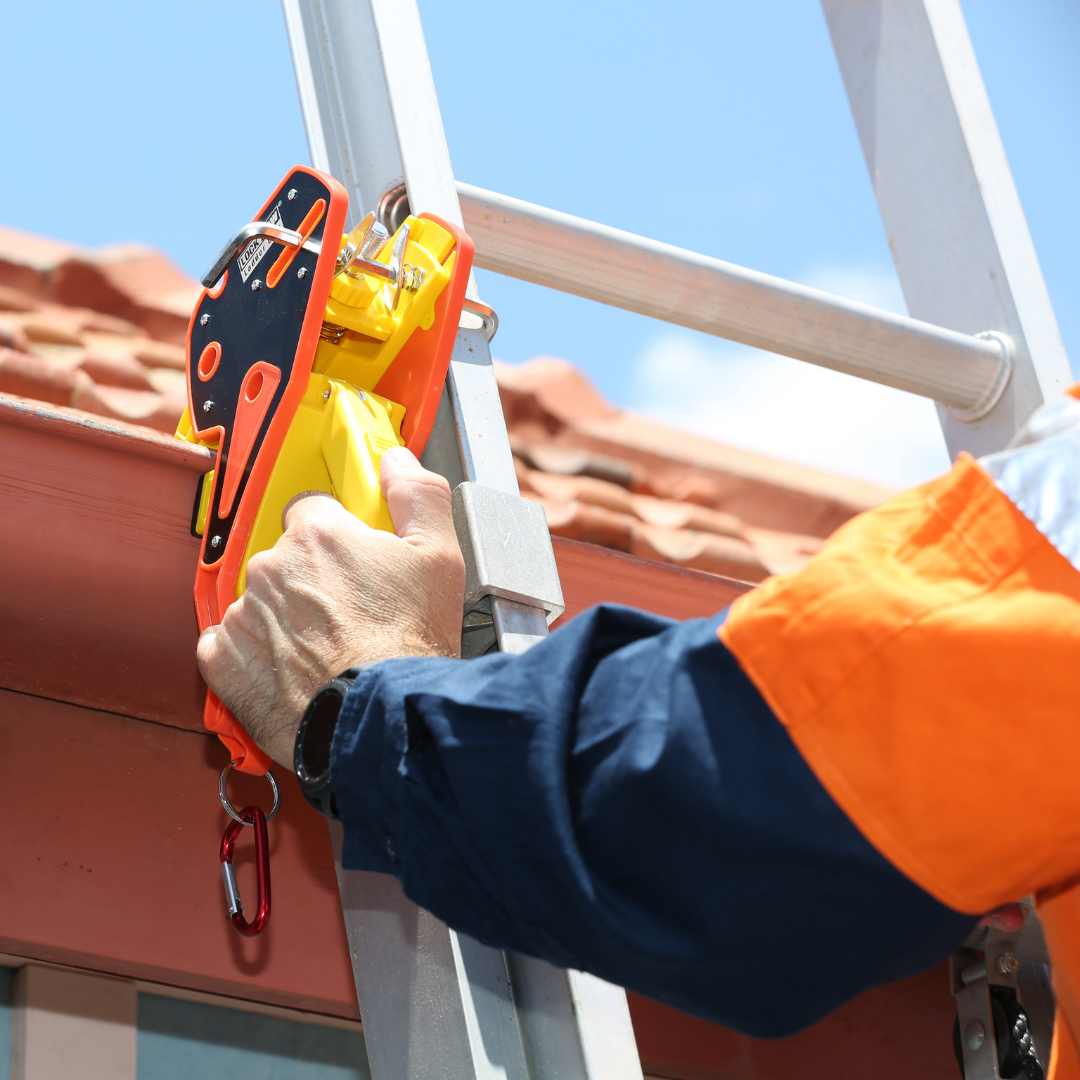
How air-conditioning technicians get to rooftop units safely by ladder.
To access a rooftop unit safely by ladder, choose a sound access point, secure the top of the ladder, extend it above the roof edge, and get your gauges and tools up without losing three points of contact. Once you’re on the roof, the roof edge needs its own protection; securing the ladder doesn’t cover that.
Choose an Access Point
Before you raise the ladder, pick where it goes. A good access point has:
- Firm, level ground at the base, clear of traffic, doors and drains.
- A sound support at the top: a solid metal gutter, a parapet wall or a structural point you can secure the ladder to.
- Clearance from power lines, including the supply to the unit you’re working on.
- A short, clear route to the unit once you’re on the roof, away from skylights and fragile roof sheeting.
- A built-in option, if there is one. If the building has a fixed access ladder, stairs or roof hatch, use that instead of a portable ladder.
Parapets
On commercial buildings, the ladder often rests against a parapet wall. Extend the ladder far enough above the parapet to give you a handhold as you step over, and don’t rely on a parapet capping or flashing to hold the ladder. Secure it to a solid point on the structure instead.
Gutters
On houses and smaller buildings, the ladder usually rests on the gutter. Check the gutter first: it needs to be sound, metal and firmly fixed. A plastic, loose, damaged or internal gutter isn’t a support you can rely on.
Secure the Ladder Top
The top needs to be secured before you climb with tools. What you use depends on what’s at the roof edge:
| At the roof edge | Secure the top with | Notes |
|---|---|---|
| A sound metal gutter with a lip | A gutter clamp | Check the gutter is firmly fixed first |
| A plastic, loose or damaged gutter | A tie-off to a rigid support on the structure | Don’t rest the ladder on the gutter |
| No gutter, or a parapet wall | A tie-off to a rigid support, such as a structural member or an installed ladder bracket | Never tie to a downpipe, gutter bracket or the unit itself |
| No suitable point at all | A different access method | Such as a fixed ladder, scaffold or elevated work platform |
Alternative securing points
If the gutter is unsound or absent, look for a rigid point on the building structure:
- An installed ladder tie-off bracket or dock, fixed into the structure at the access point.
- A structural member such as a beam, post or framing that won’t move or deflect.
- Not: downpipes, gutter brackets, conduit, refrigerant lines, the unit’s casing or a roof anchor that isn’t designed for ladders.
“If you’re using an extension ladder, secure it at the top, bottom or both. If this isn’t possible then have someone hold the ladder in place while in use.” — SafeWork NSW
Source: SafeWork NSW: Ladders (last updated December 2025, checked September 2026)
Carry Tools and Keep Contact
Rooftop AC work means more gear than most ladder jobs: manifold gauges, hoses, a vacuum pump, a recovery unit, refrigerant cylinders and a tool bag. None of it should go up in your hands.
“Only take small items up or down a ladder – never large or heavy items such as building materials.” — SafeWork NSW
“Only carry items that allow you to maintain three points of contact.” — SafeWork NSW
- Gauges and hoses: pack them in a bag and haul it up on a line once you’re on the roof.
- Heavy equipment: vacuum pumps, recovery units and cylinders should go up by haul line or hoist, or by another access method, not carried on the ladder.
- Small hand tools: in a tool belt or pouch, with lanyards on anything that could fall on someone below.
- Keep the area below clear while you’re hauling gear up.
If you’re using Lock Jaw Ladder Grip to secure the top, its supplied carabiner clips to a belt loop, so three points of contact are kept while climbing.

Clipped to the belt with the supplied carabiner, leaving both hands free
Source: SafeWork NSW: Ladders (last updated December 2025, checked September 2026)
Follow Local Ladder Rules
In NSW, SafeWork NSW’s ladder guidance sets out the key points for rooftop access by ladder:
“Always set up the ladder on a flat, stable surface. If this isn’t possible then use a ladder that includes ladder safety devices like leg levellers, anti-slip gutter guards and stabilisers.” — SafeWork NSW
“Always maintain three points of contact when climbing or descending the ladder. This means two hands and one foot, or two feet and one hand.” — SafeWork NSW
“Extension ladders should be angled at a ratio of 1:4. That is, position the base of the ladder 1 metre away from the structure for every 4 metres of height.” — SafeWork NSW
“You should also consider alternatives to a ladder, such as scaffolding or an elevated work platform.” — SafeWork NSW
Source: SafeWork NSW: Ladders (last updated December 2025, checked September 2026)
Rooftop protection is different from ladder securing
Securing the ladder and protecting yourself on the roof are two separate jobs:
- Ladder securing stops the ladder slipping or moving while you climb and step on and off.
- Rooftop protection, such as edge protection, guardrails, or a harness connected to a rated roof anchor, protects you from falling once you’re on the roof, especially near the edge or near skylights and fragile sheeting.
A secured ladder doesn’t protect you on the roof, and a roof anchor isn’t a ladder tie-off unless it’s designed for that. SafeWork NSW’s ladder guidance covers the ladder; managing the risk of falls on the roof itself is covered by the Managing the risk of falls at workplaces Code of Practice.
FAQs
How do HVAC technicians get gauges and tools onto the roof?
Pack them in a bag and haul it up on a line once you’re on the roof. Keep your hands free for three points of contact while climbing.
What if the gutter isn’t strong enough?
Don’t rest the ladder on it. Tie the ladder to a rigid support on the building structure, or use another access method.
Can I lean the ladder on a parapet wall?
Yes, if the parapet is solid. Extend the ladder enough to give you a handhold as you step over, and secure it to a solid point on the structure.
Is securing the ladder enough to protect me on the roof?
No. Ladder securing stops the ladder moving. Once you’re on the roof, you need separate protection from falls, such as edge protection or a harness and rated anchor.
Can I tie the ladder to the AC unit?
No. Tie only to a rigid point on the building structure that won’t move, not to the unit, its pipes or its casing.
How do I carry a gutter clamp up the ladder?
Lock Jaw’s supplied carabiner clips to a belt loop, so three points of contact are kept while climbing.
Related Reading
Accessing rooftop units from a sound gutter?