What OSHA requires, paragraph by paragraph.
OSHA’s ladder standard, 29 CFR 1926.1053, requires a portable ladder to be secured whenever it could be displaced: on a surface that isn’t stable and level, on a slippery surface without slip-resistant feet, and anywhere work or traffic could knock it. For roof access, the ladder must extend at least 3 feet above the landing, or be secured at the top to a rigid support with a grasping device. It must also be set at about a 4-to-1 angle.
Below, we go through each paragraph, what it means when you’re working at a house, how fixed ladders differ, and how to inspect your ladder.
OSHA Rule by Paragraph
These five paragraphs of 1926.1053 cover how a portable extension ladder must be set up and secured. 1926.1053 is part of OSHA’s construction standards.
| Paragraph | What it covers | What it means in practice |
|---|---|---|
| (b)(1) | Extension above the landing | 3 feet above the roof edge, or secure the top to a rigid support and provide a grasping device |
| (b)(5)(i) | Ladder angle | About 1 foot out at the base for every 4 feet of working length |
| (b)(6) | Stable, level surfaces | Secure the ladder unless the surface is stable and level |
| (b)(7) | Slippery surfaces | Secure the ladder or use slip-resistant feet, and still take care |
| (b)(8) | Traffic and workplace activity | Secure the ladder or barricade the area |
(b)(1): 3 feet above the landing, or secured at the top
“When portable ladders are used for access to an upper landing surface, the ladder side rails shall extend at least 3 feet (.9 m) above the upper landing surface to which the ladder is used to gain access; or, when such an extension is not possible because of the ladder’s length, then the ladder shall be secured at its top to a rigid support that will not deflect, and a grasping device, such as a grabrail, shall be provided to assist employees in mounting and dismounting the ladder. In no case shall the extension be such that ladder deflection under a load would, by itself, cause the ladder to slip off its support.” — OSHA 1926.1053(b)(1)
This gives you two ways to comply when you use a ladder to reach a roof:
- Option 1: extend the side rails at least 3 feet above the landing. This gives you something to hold as you step on and off.
- Option 2: if the ladder is too short for that, secure the top to a rigid support that will not deflect, and provide a grasping device, such as a grabrail, to help you get on and off.
Either way, the ladder must not be able to slip off its support just because it flexes under load.
(b)(5)(i): the 4-to-1 angle
“Non-self-supporting ladders shall be used at an angle such that the horizontal distance from the top support to the foot of the ladder is approximately one-quarter of the working length of the ladder (the distance along the ladder between the foot and the top support).” — OSHA 1926.1053(b)(5)(i)
In practice: for every 4 feet of working length, set the base about 1 foot out from the top support. For example, a ladder with 16 feet of working length should have its base about 4 feet out. OSHA’s QuickCard puts it the same way: place the base “a quarter of the working length of the ladder from the wall or other vertical surface.”
(b)(6): stable and level surfaces
“Ladders shall be used only on stable and level surfaces unless secured to prevent accidental displacement.” — OSHA 1926.1053(b)(6)
If the ground is soft, sloping or uneven, the ladder must be secured. Setting it on a firm, level base is the first step.
(b)(7): slippery surfaces
“Ladders shall not be used on slippery surfaces unless secured or provided with slip-resistant feet to prevent accidental displacement. Slip-resistant feet shall not be used as a substitute for care in placing, lashing, or holding a ladder that is used upon slippery surfaces including, but not limited to, flat metal or concrete surfaces that are constructed so they cannot be prevented from becoming slippery.” — OSHA 1926.1053(b)(7)
Slip-resistant feet help, but OSHA is clear that they don’t replace careful placement, lashing or holding the ladder on surfaces like flat metal or concrete.
(b)(8): traffic and workplace activity
“Ladders placed in any location where they can be displaced by workplace activities or traffic, such as in passageways, doorways, or driveways, shall be secured to prevent accidental displacement, or a barricade shall be used to keep the activities or traffic away from the ladder.” — OSHA 1926.1053(b)(8)
At a house, this usually means driveways, garage doors, paths and doorways. Secure the ladder, or barricade the area so people and vehicles stay clear.
Source: OSHA ladder standard 1926.1053 (last amended April 2014, checked September 2026)
Securing at a House
Here’s how those paragraphs come together when you’re setting up an extension ladder to reach a roof or gutter:
- Check the area first. Look for overhead power lines, and note driveways, doors and paths that need a barricade ((b)(8)).
- Set a stable base. Use firm, level ground, or secure the base if you can’t ((b)(6)). On wet paving or other slippery surfaces, secure it or use slip-resistant feet ((b)(7)).
- Set the angle. About 1 foot out for every 4 feet of working length ((b)(5)(i)).
- Extend it 3 feet above the roof edge ((b)(1)). If the ladder can’t reach that far, secure the top to a rigid support and provide a grasping device, or use a longer ladder.
- Rest both rails equally on the top support, and keep the area around the top and bottom clear ((b)(10) and (b)(9)).
- Secure the top so it can’t slide sideways as you step on and off.
Securing the top at the gutter
OSHA doesn’t name gutters specifically. What matters is that the ladder is secured and the support doesn’t move. A gutter that’s loose, damaged or flexing isn’t a support you can rely on. Common options at a house:
- Gutter clamp on a sound metal gutter with a lip.
- Tie-off to a rigid anchor point on the building structure.
- Standoff resting on the roof, where the gutter can’t take the load.

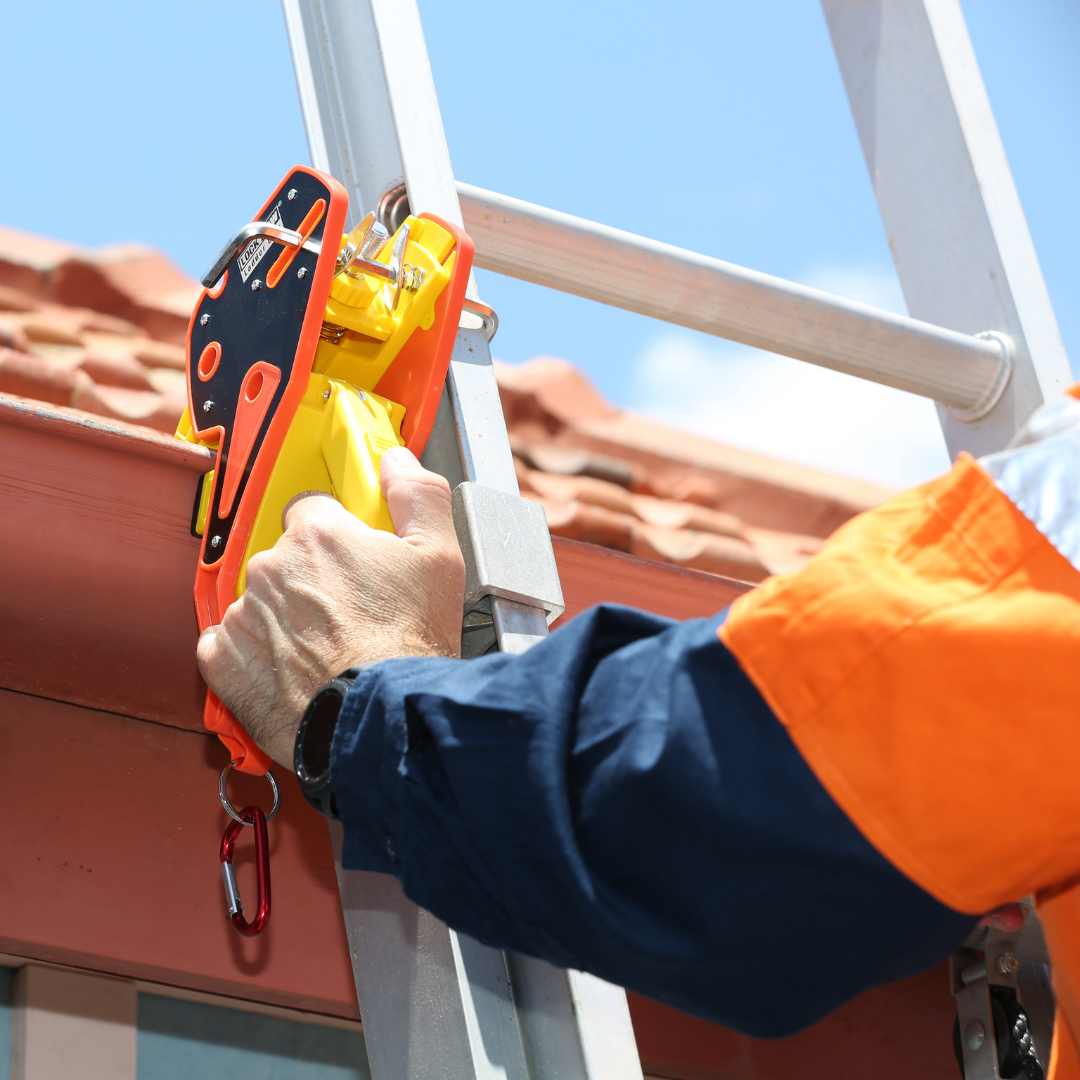
A gutter clamp holding the ladder rail to a K-style gutter
Lock Jaw Ladder Grip is one gutter clamp option. It meets the general requirements of ANSI-ASC A14.8-2013, and OSHA recommends securing ladders during use. Lock Jaw is not “OSHA certified”: OSHA sets workplace rules but doesn’t certify ladder accessories.
Learn more on our OSHA requirements page.
Different Fixed-Ladder Rule
Everything above is about portable ladders. Fixed ladders, the kind permanently attached to a building or structure, are covered by a different part of the same standard, 1926.1053(a), with their own fall protection rules based on the length of the climb:
“Fixed ladders shall be provided with cages, wells, ladder safety devices, or self-retracting lifelines where the length of climb is less than 24 feet (7.3 m) but the top of the ladder is at a distance greater than 24 feet (7.3 m) above lower levels.” — OSHA 1926.1053(a)(18)
“Where the total length of a climb equals or exceeds 24 feet (7.3 m), fixed ladders shall be equipped with one of the following: ladder safety devices; or self-retracting lifelines, and rest platforms at intervals not to exceed 150 feet (45.7 m); or a cage or well, and multiple ladder sections, each ladder section not to exceed 50 feet (15.2 m) in length.” — OSHA 1926.1053(a)(19)
So the 3-foot rule and the 4-to-1 angle in this article apply to portable extension ladders. If you’re climbing a fixed ladder, check the fixed-ladder rules instead.
Source: OSHA ladder standard 1926.1053 (last amended April 2014, checked September 2026)
Inspection and the NIOSH App
Securing a ladder only helps if the ladder itself is sound. OSHA requires inspection:
“Ladders shall be inspected by a competent person for visible defects on a periodic basis and after any occurrence that could affect their safe use.” — OSHA 1926.1053(b)(15)
“Always inspect the ladder prior to using it. If the ladder is damaged, it must be removed from service and tagged until repaired or discarded.” — OSHA Portable Ladder Safety QuickCard
Before each climb, check the rails, rungs, feet and locks, and make sure all locks on an extension ladder are properly engaged.
The NIOSH Ladder Safety app
NIOSH, the US research agency for workplace safety, publishes a Ladder Safety app for iPhone, iPad and Android. It includes:
- An angle measuring tool that uses visual, sound and vibration signals to help you set an extension ladder at about 75 degrees. That’s roughly the same angle as the 4-to-1 ratio.
- An inspection checklist for checking the ladder before use.
- Selection, proper use and accessories guides.
Source: NIOSH Science Blog: Ladder Safety App (published February 2016, checked September 2026)
Source: OSHA Portable Ladder Safety QuickCard (publication OSHA 3246, checked September 2026)
FAQs
Does OSHA require ladders to be tied off?
Not in every case. OSHA 1926.1053 requires a ladder to be secured when it isn’t on a stable, level surface, when it’s on a slippery surface without slip-resistant feet, where traffic or work could displace it, and at the top when it can’t extend 3 feet above the landing.
How far above the roof must a ladder extend?
At least 3 feet above the landing, under 1926.1053(b)(1). If the ladder is too short, the top must be secured to a rigid support that won’t deflect, with a grasping device such as a grabrail.
What is the 4-to-1 rule?
For every 4 feet of working length, set the base about 1 foot out from the top support. It comes from 1926.1053(b)(5)(i).
Can I secure a ladder to a gutter?
OSHA doesn’t name gutters. The support must be secure and not move, so only a sound, stable gutter is suitable. If the gutter is loose or damaged, tie to a rigid anchor on the building instead.
Is Lock Jaw OSHA certified?
No. OSHA doesn’t certify ladder accessories. Lock Jaw meets the general requirements of ANSI-ASC A14.8-2013.
Do the same rules apply to fixed ladders?
No. Fixed ladders are covered by 1926.1053(a), which has separate rules, including fall protection based on the length of the climb.
Related Reading
Securing the top at a sound metal gutter?